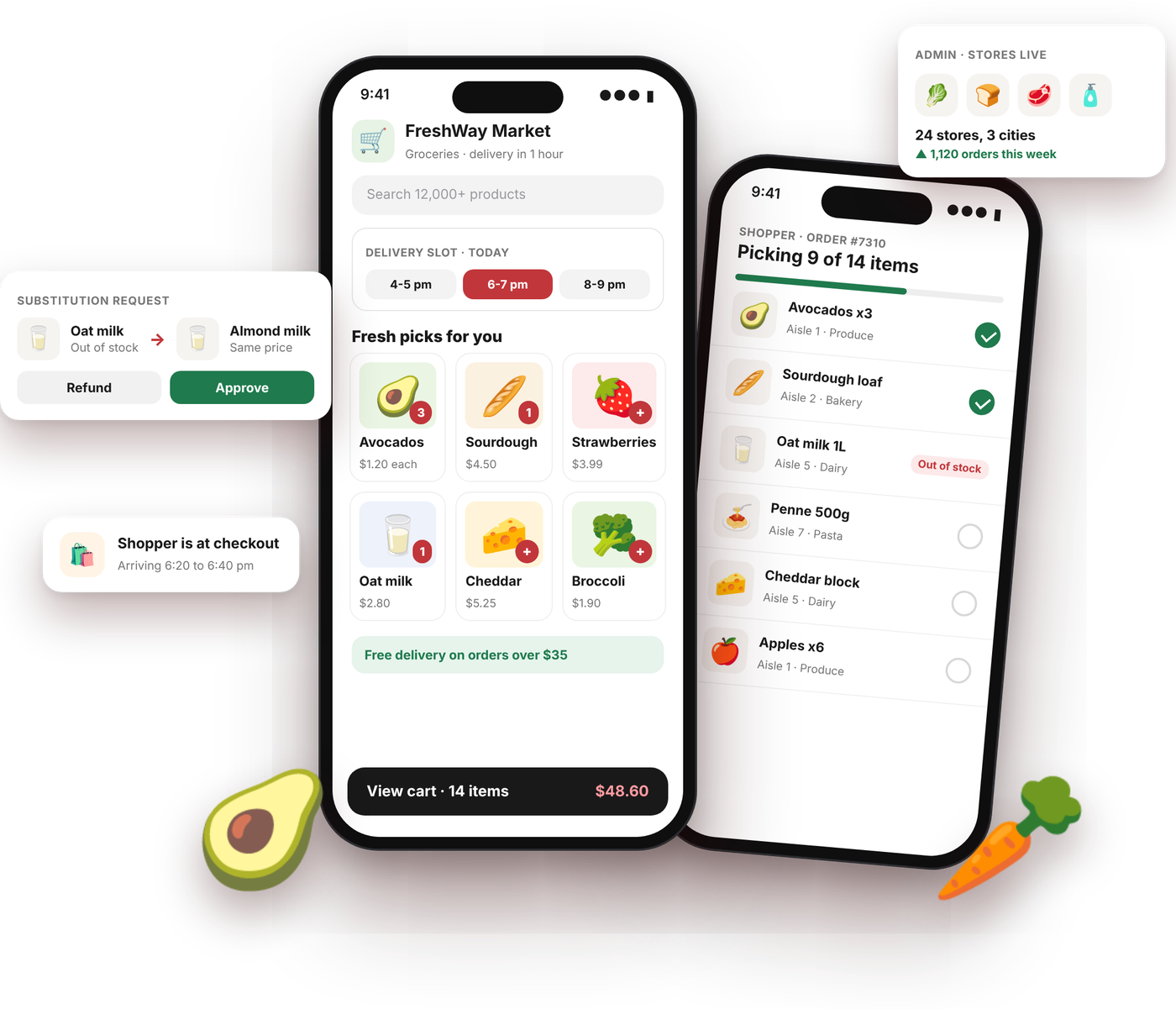
Launch a grocery delivery app like Instacart, where your shoppers pick orders in local stores and deliver them the same day. Our Instacart clone app gives customers delivery slots and easy substitutions, gives shoppers a clear picking list, and gives you one dashboard for every store, order, and payout.
Grocery delivery is a different job from restaurant delivery. Orders are bigger, items run out, and customers care about getting the right brand of milk. An Instacart clone app built for that, with shoppers, picking lists, and substitutions, keeps orders accurate and customers coming back. Fill in the form for a scope, timeline, and quote within 24 hours.
🔒 Your information is secure. We respect your privacy.
Grocery delivery has more moving parts than a takeaway. Here's every step of one order, from cart to doorstep, and how the app handles each one.
Picks a store, fills the cart, and books a delivery slot.
The nearest available shopper gets the order and heads to the store.
The app sorts the list by aisle, and each item is scanned as it goes in the trolley.
If something is out of stock, the customer approves a swap or gets a refund in the app.
The final bill updates with real prices and weights, and the customer sees it.
The customer tracks the shopper and gets a photo when the bags reach the door.
Most food apps only need a driver. A grocery app needs a shopper, someone who can find the right items, make smart swaps, and get them home. That's why the shopper app gets the most attention.
Store search, delivery slots, saved lists, swap approvals, and live order tracking.
Product catalog, prices, stock levels, promotions, and order history for each partner store.
Stores, shoppers, delivery zones, fees, markups, refunds, and revenue reports in one place.
A wrong item in a grocery order is the fastest way to lose a customer. These features are there to make every basket right, and to make the next order easier.
Getting orders right
Customers pick their backup choice in advance, or approve swaps live.
Shoppers scan every item, so the wrong size or brand gets caught early.
Shoppers can send a photo of a product before swapping it.
Making it easy to order
Customers choose a one-hour window today, tomorrow, or later in the week.
Weekly shops saved as lists, so a full cart is one tap away.
Order from a grocer and a pharmacy in one checkout.
Helping stores sell more
Catalogs update from the store's system, so fewer items show as available when they are not.
Stores run their own deals, bundles, and loyalty discounts.
Frozen and chilled items are picked last and flagged for quick delivery.
Already Talking to Local Stores?
Tell us which grocers you plan to start with. We'll shape your Instacart clone around them and send a scope and price within 24 hours.
The same Instacart clone can run a marketplace, a single chain, or a warehouse. Pick the one that matches what you have today.
Many grocers, pharmacies, and specialty shops in one app, with your shoppers picking from each.
You need: store partnerships and a pool of shoppers.
A grocery chain gives its own customers delivery under its own brand, with its own staff picking orders.
You need: a store team and a delivery partner or drivers.
Orders are picked from your own warehouse instead of a public shop, which makes picking faster and more accurate.
You need: a small warehouse and stock you buy yourself.
Grocery baskets are larger than takeaway orders, so each order can carry more income. Here are the ways a grocery app earns, all set from your dashboard.
A percentage of each order paid by partner stores.
A small markup on product prices, common in grocery delivery.
Charged by slot, distance, or basket size, with free delivery above a minimum.
A small per-order fee that covers card costs and support.
A monthly plan with free delivery for regular weekly shoppers.
Grocery brands pay to feature products in search and on the home screen.
Not Sure Which Grocery Model Fits?
Book a free call. We'll talk through marketplace, single store, or dark store, and help you pick the one to launch with.
A grocery app has more moving parts than most. You need a team that has thought about shoppers, swaps, and stock, and one that hands you the keys when the work is done.
Four stages, each one signed off by you before the next begins.
We map your stores, delivery area, and business model, then send a written scope and price.
You approve every screen of the customer, shopper, and store apps before development starts.
We develop the apps, connect store catalogs, payments, and maps, and test real shops end to end.
Your apps go live on the App Store and Google Play, and we help onboard stores and your first shoppers.
Cutting-edge technology stack powering successful delivery platforms worldwide
Purchasing DeliveryBee was a great decision for launching our food delivery business. The setup was straightforward, and whenever we had questions about configuring the platform, the DeliveryBee team was quick to guide us. Features like restaurant management and real-time order tracking have made day-to-day operations much easier. The support we received after purchase gave us the confidence to move forward.”

DeliveryBee helped us launch our food delivery platform without having to build everything from scratch. After purchasing the solution, we needed some help with the initial setup and configuration, and the support team guided us through the process. The customer ordering app and restaurant management features are easy to understand, and our team was able to start using them quickly.

We purchased the DeliveryBee Food Delivery App to start our own branded delivery platform, and the overall experience has been very smooth. The team helped us understand the installation and configuration process, and we were able to get familiar with the system quickly. We particularly liked the easy order management and delivery tracking features.

Answers for founders planning a grocery delivery app like Instacart, from shoppers and substitutions to cost and code ownership.
An Instacart clone app is a grocery delivery platform built on the same model as Instacart. Customers order from local stores, a shopper picks the items in store, and the groceries are delivered the same day. It includes a customer app, a shopper app, a store panel, and an admin dashboard, all under your brand.
When an item is missing, the shopper app suggests a replacement and sends it to the customer, who approves the swap or asks for a refund in the app. Customers can also choose a backup item when they order, so the shopper knows what to pick if the first choice is gone.
Not always. You can run a marketplace with partner stores, deliver for a single store or chain, or pick orders from your own small warehouse, known as a dark store. Many founders start with a few local stores, then add more once orders grow.
It depends on your business model, how many stores you connect, the features you need, and the areas you launch in. Share your plan through the form and you'll get a written scope and a clear price within 24 hours.
Yes. You get the full source code, design files, and your apps listed under your own App Store and Google Play accounts. You pay once for the build, with no monthly license, and you're free to work with any developer later.
Still deciding between grocery and food, or clone and custom? These pages cover the closest options.
Want a grocery app that doesn't follow the Instacart model? Build one around your own store and workflow.
View servicePlanning to sell meals as well as groceries? Our DoorDash clone runs restaurants and stores in one marketplace.
View clone appFocused on restaurant orders in the city? See our Uber Eats clone with group orders and quick pickup.
View clone appCompare every app we build on a proven model, from grocery and food delivery to ride-hailing.
View serviceTell us your area, the stores you want to work with, and how you plan to deliver. We'll send a plan, timeline, and price for your grocery delivery app, with no obligation.