Taking a Regional Taxi Business Into New Cities With Its Own App
Back DeliveryBee • Taxi App Case Study Taking a Regional Taxi Business Into New Cities With Its Own App A look at how one taxi business moved from dispatcher phone calls to an owned app and expanded into cities it couldn’t reach before. The Client and Their Challenge Our client ran a regional taxi business […]
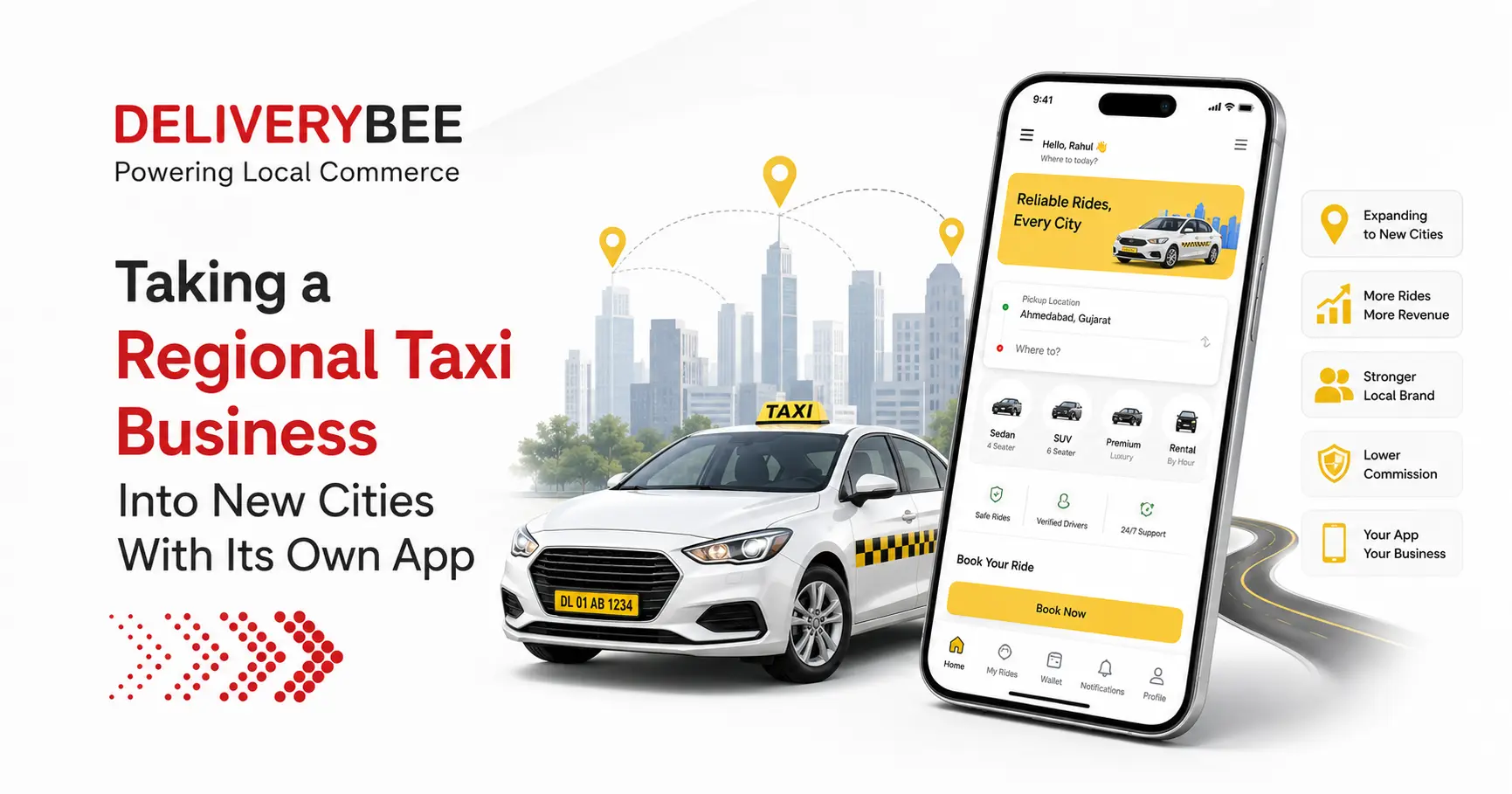
Taking a Regional Taxi Business Into New Cities With Its Own App
A look at how one taxi business moved from dispatcher phone calls to an owned app and expanded into cities it couldn't reach before.
The Client and Their Challenge
Our client ran a regional taxi business that relied on phone dispatchers to match riders with available drivers. That model worked in their home city, but expanding into new cities meant hiring and training more dispatchers for every market, an approach that couldn't scale fast enough to compete with app based ride hailing services already operating nationally.
Riders increasingly expected to book a ride from their phone with visible pricing and driver tracking, something a phone dispatch model simply couldn't offer.
How We Resolved It
We delivered a white label ride hailing app rebranded for the client, with a rider app, a driver app, and a real time dispatch system that matched rides automatically based on driver location and availability. The admin panel let the client configure each new city as its own zone, setting fare rules and driver onboarding without dispatchers on the ground in every market.
Drivers got their own app with earnings visibility and ride history, replacing radio based dispatch with a system that ran itself.
Challenges We Faced Along the Way
- Balancing dispatch fairly across drivers. With drivers spread unevenly across zones, the matching logic had to route rides fairly instead of favoring whichever driver happened to be closest to the dispatcher's usual routine.
- Bringing drivers onto a new system. Many drivers were used to radio dispatch and had never worked from an app before, so onboarding needed to be simple enough not to slow down daily operations.
- Tuning pickup estimates across different city layouts. Each new city had different traffic patterns and road structures, so pickup time estimates needed calibration city by city to stay accurate.
The Outcome
The client expanded into new cities without hiring a dispatcher for each one, using the same app and admin panel to manage every market. Riders got visible pricing and live tracking for the first time, and drivers adapted to the app faster than expected once they saw it meant more consistent ride assignments than radio dispatch had offered.
"We couldn't scale dispatchers fast enough to keep up with expansion. Now we open a new city from the same admin panel we've always used, and our drivers actually prefer the app over the radio."
Frequently Asked Questions
Can the same app expand into multiple cities?
Yes. Each city can be configured as its own zone with its own fare rules and driver pool, managed from one admin panel.
How does ride matching work between riders and drivers?
Rides are matched automatically based on driver location and availability in real time, rather than manual dispatch.
Is driver onboarding difficult for drivers new to app based dispatch?
The driver app is built to be simple to learn, with earnings and ride history visible from day one, which most drivers adapt to quickly.
Do we own the app after it's built?
Yes. DeliveryBee's white label license is a one time payment that includes full source code and IP ownership.
How long does it take to launch a white label taxi app?
Most launches with DeliveryBee go live within 3 to 4 weeks, depending on how much rebranding and payment integration the project needs.
Have a Taxi App Idea Ready to Launch?
Get a free scope and quote within 24 hours.
- Email: sales@deliverybee.app
- WhatsApp: +91 7877680810