For many logistics businesses, the most common customer question is simple:
“Where is my shipment?”
In traditional freight operations, answering that question can involve emails, phone calls, carrier websites, transporters and internal teams.
A modern freight tracking system changes this experience.
Instead of relying on manual updates, customers and logistics teams can access shipment information through a centralized digital platform.
Real-time tracking has therefore become an important part of modern freight management software, transportation platforms and logistics applications.
What Is a Freight Tracking System?
A freight tracking system is software that allows logistics companies, freight forwarders, carriers and customers to monitor shipments during transportation.
Depending on the logistics model, tracking may include:
- Shipment status
- Vehicle location
- GPS position
- Pickup status
- Transit status
- Port status
- Customs status
- Estimated delivery time
- Delivery confirmation
The objective is simple:
Make shipment movement visible.
Why Freight Visibility Matters
A logistics company can successfully transport cargo and still provide a poor customer experience if customers have no visibility.
Customers want to know:
- Has the shipment been picked up?
- Has it left the origin?
- Where is it now?
- Has it reached customs?
- When will it arrive?
- Has delivery been completed?
A digital shipment tracking system can answer these questions without requiring customers to contact an employee.
Problems With Manual Shipment Tracking
Manual tracking creates several challenges.
- Multiple Tracking Sources
A freight forwarder may work with several carriers and transport companies.
Each may have different tracking mechanisms. - Delayed Updates
Manual updates may not reflect the actual shipment position immediately. - Customer Service Pressure
When customers cannot track shipments independently, operations teams receive repeated tracking requests. - Limited Historical Data
If shipment events are stored across emails and spreadsheets, historical analysis becomes difficult.
Real-Time Shipment Tracking Software
A modern tracking platform can connect different information sources through APIs and integrations.
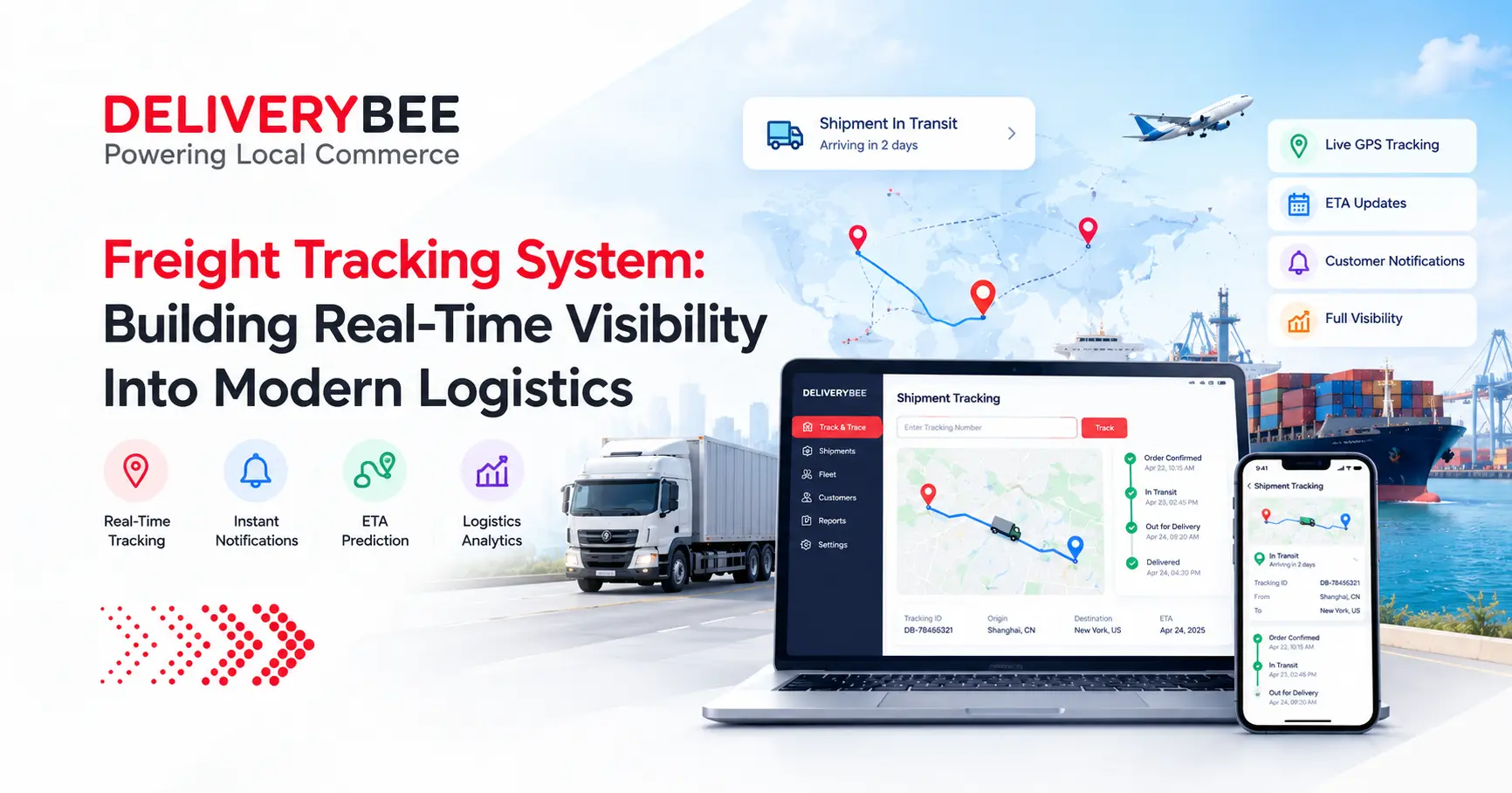
The system can consolidate shipment events into a single timeline.
For example:
Booking Confirmed
↓
Cargo Picked Up
↓
Container Loaded
↓
Departed Origin
↓
In Transit
↓
Arrived at Destination
↓
Customs Clearance
↓
Out for Delivery
↓
Delivered
This creates a consistent shipment journey.
Customer Tracking Portal
One of the most valuable components is the customer-facing tracking page.
Customers can enter a shipment number and view:
- Current status
- Origin
- Destination
- Shipment history
- Estimated arrival
- Delivery status
- Important notifications
For businesses, a branded tracking portal can become an important part of the customer experience.
Mobile Freight Tracking App
A mobile application can provide additional functionality.
Customers can receive push notifications when:
- Shipment is booked
- Pickup is completed
- Shipment departs
- Shipment reaches a major milestone
- Delay occurs
- Delivery is scheduled
- Shipment is delivered
Drivers can use another mobile application for operational activities.
GPS and Vehicle Tracking
For road freight, GPS tracking can provide vehicle-level visibility.
The operations team can see:
- Vehicle location
- Current trip
- Driver
- Route
- Distance
- Estimated arrival
- Delivery stops
This information can be displayed on a centralized logistics dashboard.
AI-Powered ETA Prediction
Basic tracking tells you where the shipment is.
AI can help estimate where it will be.
An AI-powered logistics platform can use historical and live data to improve estimated arrival times.
Potential data inputs include:
- Current location
- Historical transit times
- Route characteristics
- Traffic
- Delivery sequence
- Driver behavior
- Previous delays
The result can be a more dynamic ETA rather than a fixed delivery estimate.
AI Delay Detection
Another useful capability is automated delay detection.
The platform can monitor shipment progress and identify when a shipment deviates from its expected schedule.
For example:
Expected checkpoint: 2:00 PM
Actual checkpoint: 5:00 PM
The system identifies a delay.
An AI layer could then determine whether the delay is likely to affect the final delivery schedule.
The operations team receives an alert before the customer has to ask.
Freight Tracking + SailOn Logistics
DeliveryBee has provided a digital solution for SailOn Logistics, a freight and logistics company offering international transportation services.
SailOn’s logistics operation includes shipment planning, freight services, container transportation and real-time shipment tracking.
This provides a useful example of how freight companies can use digital technology to make logistics services easier to access and monitor.
The broader objective is not simply tracking.
It is shipment visibility from booking through delivery.
Freight Tracking Dashboard
A logistics operations dashboard can provide a complete overview.
Management can monitor:
- Total active shipments
- In-transit shipments
- Delayed shipments
- Delivered shipments
- Pending bookings
- Vehicle activity
- Route performance
- Customer activity
This turns tracking data into operational intelligence.
Digital Proof of Delivery
Tracking should not stop when the vehicle reaches the destination.
A modern platform can include digital proof of delivery.
Drivers can capture:
- Signature
- Photo
- OTP
- Timestamp
- GPS location
This creates a digital delivery record.
DeliveryBee’s courier platform already supports proof-of-delivery workflows alongside shipment booking, tracking, route optimization and fleet management.
Freight Tracking API Integration
A custom platform can also integrate external systems.
Potential integrations include:
- GPS providers
- Carrier APIs
- Mapping APIs
- ERP systems
- CRM systems
- Payment gateways
- Warehouse systems
- Transportation systems
This enables businesses to build a centralized logistics visibility platform rather than forcing employees to use multiple systems.
Why Build Custom Freight Tracking Software?
Every freight company has different requirements.
Some specialize in:
- Ocean freight
- Air freight
- Road transportation
- FCL
- LCL
- Project cargo
- International freight forwarding
- Last-mile delivery
A custom tracking system allows the workflow to reflect the company’s operational model.
The Future of Freight Visibility
The future of freight tracking will go beyond showing a moving dot on a map.
The next generation of freight visibility platforms will increasingly combine:
Tracking + ETA + AI + Automation + Customer Communication + Analytics
That means logistics companies can move from simply answering “Where is my shipment?” to answering more valuable questions:
Will my shipment arrive on time?
Is this shipment at risk?
What should our operations team do next?
This is where freight tracking software becomes a strategic logistics platform rather than simply a tracking tool.