Introduction: Search Is Evolving, but SEO Still Matters
For years, businesses have invested in Search Engine Optimization (SEO) to improve Google rankings, attract organic website traffic and generate leads. A strong SEO strategy remains an important part of digital marketing. However, the way people discover and evaluate businesses is evolving.
Customers can now ask AI-powered search experiences and assistants to explain complex topics, compare service providers, research products and suggest solutions. Instead of receiving only a list of links, they may receive a synthesized answer with supporting sources.
This shift has introduced two increasingly discussed marketing terms: Answer Engine Optimization (AEO) and Generative Engine Optimization (GEO).
If your business already invests in SEO, you may be asking:
- Is traditional SEO becoming less important?
- What is the difference between AEO and GEO?
- How can a business improve its visibility in AI-generated answers?
- Should you hire an AEO or GEO agency?
- Do you need a separate AI search marketing strategy?
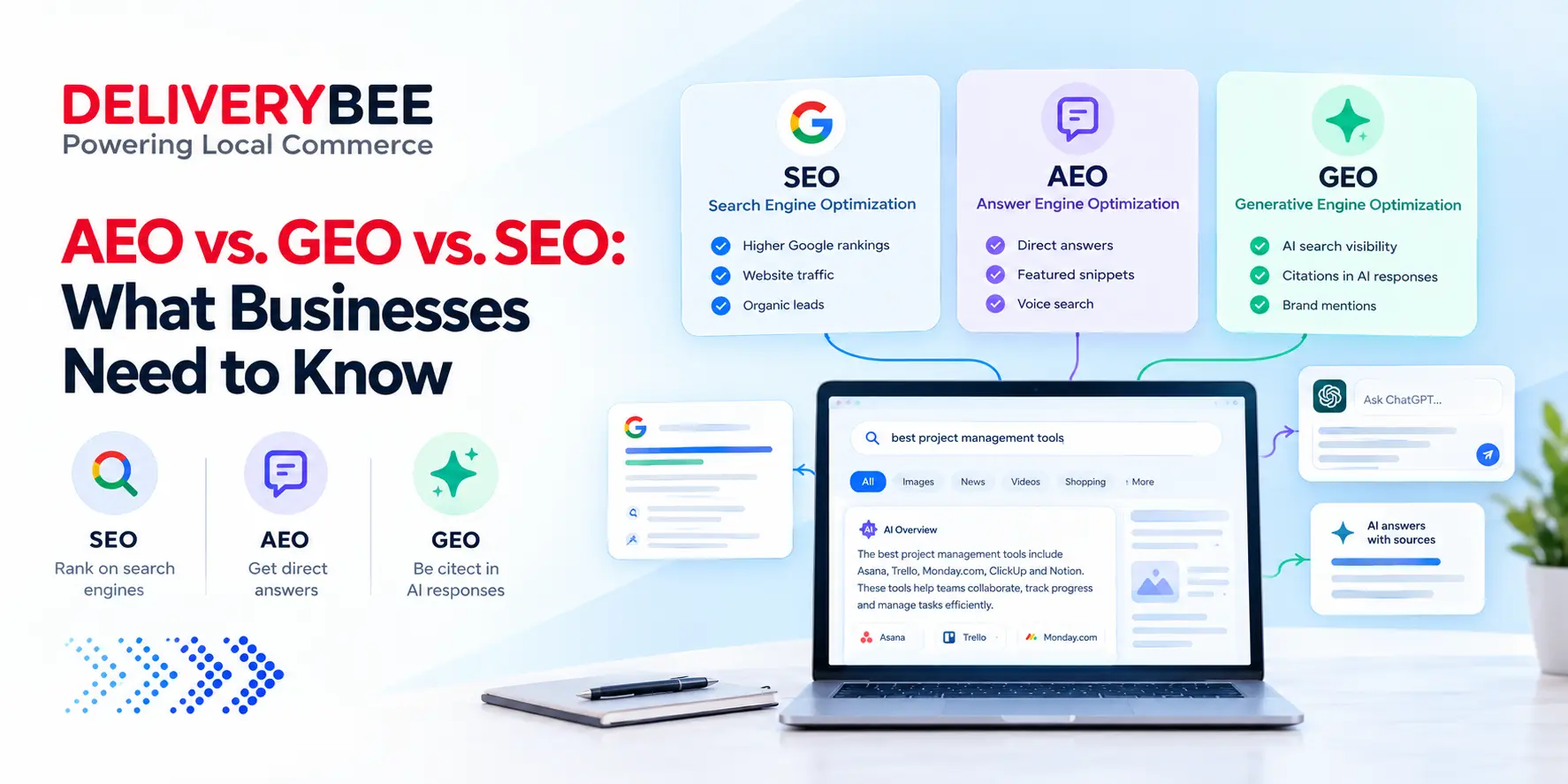
The short answer is that SEO, AEO and GEO are overlapping approaches to digital discoverability, not three completely separate marketing systems.
SEO establishes the foundation for search visibility. AEO emphasizes making content useful for direct answers. GEO emphasizes improving the discoverability and potential citation of your content and brand in generative AI responses.
For businesses looking to prepare for this evolution, the opportunity is to build on existing SEO investments while developing a more complete approach to AI search visibility.
At DeliveryBee, our AEO and GEO marketing approach focuses on helping businesses improve website accessibility, content quality, brand clarity and measurable digital visibility.
What Is SEO? Search Engine Optimization Explained
Search Engine Optimization is the process of improving a website’s visibility in organic search results.
When potential customers search for products, services or information, search engines evaluate many signals to determine which pages may be relevant and useful.
SEO helps businesses make their websites easier to discover, understand and navigate.
Key components of SEO
- Technical SEO: Ensuring that search engines can access, crawl and index important pages, with appropriate site architecture, redirects, canonical URLs and performance.
- On-page SEO: Improving page titles, headings, content, internal links and other elements that help communicate a page’s purpose.
- Content strategy: Creating relevant, accurate and useful content that addresses customer needs and search intent.
- Authority and reputation: Building a credible digital presence through useful resources, relevant editorial references and genuine industry recognition.
- Measurement: Tracking organic impressions, clicks, search queries, conversions and other meaningful performance indicators.
For example, a company providing mobile application development might create a service page targeting “mobile app development company” and supporting content about app development costs, technology choices and project planning.
A well-planned SEO strategy helps the business attract relevant searchers and gives those visitors useful information to evaluate its services.
SEO remains relevant even as search interfaces evolve. Google explains in its official documentation that the established SEO fundamentals continue to apply to its AI-powered search experiences. There are no special AI-specific schema types or additional technical requirements that guarantee inclusion in AI Overviews or AI Mode.
What Is AEO? Answer Engine Optimization Explained
Answer Engine Optimization focuses on helping content provide clear, relevant answers to users’ questions.
An answer-oriented search experience may present a direct explanation, a featured result, a conversational response or a summary supported by web sources.
AEO encourages businesses to organize their content around the questions customers ask, rather than focusing exclusively on broad keywords.
Key components of AEO
- Researching common customer questions and conversational queries.
- Providing direct, accurate answers to specific questions.
- Structuring pages with descriptive headings and logical sections.
- Creating useful FAQs where they genuinely help visitors.
- Clarifying product features, services, processes and pricing information where appropriate.
- Supporting claims with reliable evidence.
- Making important information accessible in text.
- Measuring answer-oriented visibility where suitable tools and reporting are available.
Example of AEO in practice
Imagine a business offering custom e-commerce application development.
A traditional SEO page might target “e-commerce app development services.”
An AEO-focused content
strategy could also answer questions such as:
- How much does it cost to build an e-commerce app?
- Which features should an e-commerce app include?
- Should a startup choose a custom app or a ready-made platform?
- How long does e-commerce app development take?
- What integrations does an online retail app need?
These questions reflect real customer concerns and can help potential clients make better decisions.
AEO does not mean writing content solely for an AI system. The objective is to answer questions effectively for people while presenting information in a clear, accessible structure.
What Is GEO? Generative Engine Optimization Explained
Generative Engine Optimization focuses on improving the likelihood that a brand’s content and expertise are discovered, represented or cited in AI-generated responses.
Generative search systems may synthesize information from multiple sources to answer a user’s question. Depending on the platform and query, a response may include source links, citations, business mentions or recommendations.
GEO considers how clearly a business communicates its expertise and how discoverable and credible its information is across relevant digital sources.
Key components of GEO
- Clear brand information: Explain who your business serves, what it offers and how its services differ from alternatives.
- Useful, distinctive content: Publish original insights, practical explanations, evidence-backed resources and content that goes beyond generic information.
- Technical accessibility: Ensure that important pages can be discovered and accessed by the relevant search systems.
- Consistent business information: Keep your company details, services and other important public information accurate across relevant sources.
- Credible third-party references: Pursue legitimate industry coverage, expert contributions and relevant editorial mentions.
- Content depth and context: Explain complex topics thoroughly enough to address the questions potential customers may ask.
- Visibility monitoring: Assess whether your brand appears in a defined set of relevant AI-generated responses and whether those appearances are accurate.
Example of GEO in practice
Suppose a business wants to be considered when a potential customer asks an AI assistant:
“Which software development company can build a grocery delivery platform with driver tracking and an admin dashboard?”
A useful GEO strategy would help ensure that the company’s website clearly explains its relevant capabilities, supported integrations, industry experience and actual project work.
Supporting articles might explain grocery delivery app features, delivery tracking architecture, platform integration choices and implementation considerations.
If the company has relevant, verifiable case studies, those can provide additional context. Claims should reflect real experience rather than invented projects or unsupported performance figures.
These activities can improve the quality and discoverability of the business’s information. They cannot guarantee that a particular AI system will recommend the company.
AEO vs. GEO vs. SEO: The Key Differences
Although the three terms overlap, each provides a useful way to think about a different aspect of digital visibility.
- Comparison
- Full form
- Main focus
- Typical content
- Technical priorities
- Desired outcome
- Measurement
- SEO
- Search Engine Optimization
- Organic search visibility
- Service pages, landing pages, articles and resources
- Crawlability, indexing, site structure and page experience
- Relevant rankings, clicks and conversions
- Impressions, clicks, rankings and conversions
- AEO
- Answer Engine Optimization
- Clear, useful answers
- Direct answers, explanations and question-led content
- SEO accessibility plus clear information structure
- Content being surfaced or used to answer relevant questions
- Answer visibility and resulting engagement where measurable
- GEO
- Generative Engine Optimization
- Visibility in generative AI responses
- Original insights, detailed resources and clear brand information
- SEO accessibility plus discoverable, credible and well-contextualized content
- Brand or content being referenced in relevant AI-generated responses
- AI mentions, citations, referral visits and business outcomes where measurable
Important: These are practical distinctions, not universally standardized definitions. Marketing providers sometimes use AEO and GEO interchangeably. When evaluating a service, ask what work will actually be delivered and how its results will be measured.
Do Businesses Need SEO, AEO and GEO Separately?
In most cases, businesses do not need three disconnected optimization programs.
The underlying work often overlaps: technically accessible pages, useful content, clear information, relevant expertise and credible sources can support multiple forms of discovery.
A more practical way to think about the relationship is:
- SEO helps establish discoverability in search.
- AEO helps make information useful and accessible as an answer.
- GEO focuses on how a brand and its content may be represented in generative responses.
Consider a logistics software company.
Its SEO program may improve its service pages for searches related to fleet management software. Its AEO work may address questions about fleet tracking features, implementation costs and integrations. Its GEO work may improve the depth and clarity of its expertise, strengthen its relevant digital footprint and monitor its presence in AI-generated answers about logistics software.
These activities can be managed within one coordinated strategy.
Why SEO should remain the foundation
Google’s published guidance for AI features recommends continuing to follow established SEO practices, including allowing crawling, creating helpful and reliable content, ensuring important information is available as text, maintaining internal links and using structured data that matches visible content.
That means a business should be cautious about providers claiming that traditional SEO is dead or that a secret AI optimization technique can replace it.
The better question is not whether to choose SEO or GEO. It is how to make your existing digital marketing strategy work across the search experiences your customers use.
How to Move From Traditional SEO to AEO and GEO
If your business already has an SEO strategy, you can begin expanding it without rebuilding everything from scratch.
Step 1: Audit Your Current SEO Performance
Start with the information you already have.
Review your website’s technical condition, indexed pages, organic search performance, important landing pages and existing content.
Identify which pages generate qualified traffic and which pages have impressions but weak engagement or conversion performance.
Useful data sources may include Google Search Console, website analytics, CRM records and your existing SEO tools.
The aim is to understand your current position before deciding where to invest next.
Step 2: Identify the Questions Your Customers Ask
Traditional keyword research remains useful, but it should be supplemented with the questions people ask before purchasing your service.
For example, a business seeking a custom mobile application may want to know:
- What is the cost of building a mobile app?
- Which technology is appropriate for my business?
- Can the application integrate with existing software?
- How long will development take?
- What ongoing maintenance will be required?
Use customer interviews, sales conversations, support tickets, keyword research and website search data to identify these questions.
Prioritize questions that align with your services and influence purchase decisions.
Step 3: Improve Your Existing Service Pages
You do not necessarily need to publish dozens of new articles.
Start with your most important commercial pages and make sure they clearly explain:
- What you offer.
- Who the service is for.
- Which problems it solves.
- How the process works.
- What affects pricing and timelines.
- Which capabilities or integrations are supported.
- What evidence supports your expertise.
- How a potential customer can take the next step.
Add useful answers to genuine customer questions where they fit naturally.
Avoid filling pages with repetitive keywords or generic FAQs created only to increase page length.
Step 4: Build Content Around Important Topics
Develop supporting articles that answer related questions and connect to your core service pages.
For a software development business, a content cluster might include:
- Custom mobile app development costs.
- Laravel vs. Node.js for web applications.
- Grocery delivery app features.
- How route optimization software works.
- Integrating third-party delivery platforms.
- Choosing a technology partner for a startup.
Each article should provide a distinct benefit and link to relevant commercial pages where appropriate.
This approach builds a coherent resource around your expertise rather than a collection of disconnected posts.
Step 5: Improve Technical Accessibility and Brand Clarity
Review whether important pages can be crawled and indexed, whether key information is available as text, and whether internal links make relevant content discoverable.
Check your business information for accuracy and consistency.
Use appropriate structured data where it accurately describes visible content. Do not add unsupported schema, fabricate reviews or assume that a particular markup format guarantees AI citations.
For ChatGPT search, OpenAI’s publisher guidance explains that websites should avoid blocking OAI-SearchBot if they want their content to be discoverable and cited through ChatGPT search. Crawler access should be reviewed according to your business’s content-use preferences and technical requirements.
Step 6: Monitor AI Search Visibility
Choose a relevant set of questions your prospective customers might ask and test them across the AI search experiences that matter to your business.
Record:
- Whether your brand appears.
- Whether your content is cited or linked.
- Whether the information about your business is accurate.
- Which competing businesses appear.
- Whether your website receives identifiable referral visits.
- Whether those visits produce meaningful engagement or enquiries.
AI answers can vary across queries, time, geography and platform. Use a repeatable measurement process instead of relying on a single favorable response.
Step 7: Refine the Strategy Using Evidence
Use your findings to decide what to improve next.
If your website receives relevant organic impressions but few clicks, review your titles and how clearly your pages communicate value.
If customers visit your landing pages but do not enquire, investigate the offer, proof points, usability and conversion process.
If your content is difficult to discover, review internal links and technical accessibility.
If your brand is absent from a selected set of relevant AI answers, assess whether the underlying content, expertise, business information and visibility foundations need improvement.
Do not assume every problem requires more content. Sometimes a better service page, stronger evidence or a technical correction is the more valuable investment.
How Should You Measure SEO, AEO and GEO Results?
Each approach needs metrics that reflect what it is trying to achieve.
SEO metrics
- Organic search impressions and clicks.
- Relevant search queries and ranking trends.
- Organic landing page engagement.
- Qualified leads and conversions.
- Revenue or other business outcomes where attributable.
AEO metrics
- Visibility for selected answer-oriented queries.
- Inclusion in relevant answer formats where observable.
- Accuracy and usefulness of the information presented.
- Engagement or referral traffic associated with answer experiences where measurable.
GEO metrics
- Brand mentions in a defined set of AI-generated responses.
- Citation and source-link frequency.
- Accuracy of brand and service descriptions.
- Competitor visibility across the same query set.
- Referral visits from identifiable AI platforms.
- Qualified enquiries and conversions where measurable.
Do not combine these metrics into a single score without explaining the methodology.
A brand mention does not necessarily generate a click. A citation does not guarantee a lead. Organic traffic can fluctuate for reasons unrelated to AEO or GEO.
The most useful reporting connects visibility signals to the business outcomes that matter.
Common Myths About AEO and GEO
Myth 1: SEO Is Dead
Reality: SEO remains important. Established search fundamentals continue to support eligibility and discoverability in many AI-assisted search experiences. Businesses should expand their strategy rather than discard useful SEO work.
Myth 2: Adding FAQs Guarantees AI Citations
Reality: Useful FAQs can improve a page for readers, but adding them does not guarantee that an AI platform will use the content. Answers need to be relevant, accurate and supported by a strong overall website and content strategy.
Myth 3: Every Website Needs an llms.txt File
Reality: There is no universal requirement to create an llms.txt file to appear in Google AI Overviews or AI Mode. Follow documented platform guidance and prioritize established technical SEO fundamentals over unverified shortcuts.
Myth 4: Publishing More AI-Generated Content Automatically Improves Visibility
Reality: Content volume is not a substitute for usefulness, accuracy, originality or expertise. Large quantities of generic material can waste resources and create a poor user experience.
Myth 5: AEO and GEO Agencies Can Guarantee ChatGPT Recommendations
Reality: No agency controls the response-generation and source-selection systems of independent AI platforms. A credible provider should explain the work it will perform, the evidence it will collect and the outcomes it can reasonably measure.
How DeliveryBee Can Help With AEO and GEO Marketing
Businesses that want to expand beyond traditional SEO need a coordinated strategy across content, technical accessibility and digital brand information.
DeliveryBee’s approach to AEO and GEO is designed to complement existing SEO work while helping businesses prepare for evolving AI search experiences.
Depending on your requirements, the work may include:
- AI search visibility and website readiness audits.
- Conversational query and customer question research.
- Service page and content optimization.
- Content cluster planning and internal linking.
- Technical SEO and indexing reviews.
- Structured data assessment.
- Brand information consistency reviews.
- AI search visibility monitoring and reporting.
The right scope depends on your website, industry, current SEO maturity and business objectives.
For a business with a strong SEO foundation, the next step may be a targeted AEO and GEO enhancement program. For a business with technical or content gaps, strengthening the fundamentals may deliver more value before expanding into additional activities.
Explore our AEO & GEO Marketing Services to understand how your business can build a strategy around AI search visibility.
Frequently Asked Questions
SEO focuses on organic search visibility. AEO focuses on presenting useful, clear answers to customer questions. GEO focuses on improving the discoverability and potential citation of content and brand information in generative AI responses. The practices overlap and can be managed within one strategy.
Neither is universally better. SEO remains a core source of digital discoverability, while GEO addresses additional questions about how a brand and its content appear in generative AI experiences. The right investment depends on your audience, existing performance and business goals.
The terms overlap, and different providers define them differently. AEO is often used for answer-focused content and visibility, while GEO generally emphasizes generative AI systems and their responses. Businesses should evaluate the actual deliverables rather than choosing a provider based on terminology alone.
It is possible to work on content clarity and AI visibility without running a formal SEO campaign, but neglecting technical accessibility, indexability and useful content can limit discoverability. Most businesses benefit from maintaining SEO fundamentals while expanding into AEO and GEO.
Timelines vary depending on the website, technical issues, content quality, competition and implementation resources. Some improvements can be made quickly, but meaningful visibility trends and business outcomes need ongoing measurement. There is no universal timeline for gaining AI citations.
Structured data can help describe content to supported systems when implemented correctly, but it does not guarantee AI citations or recommendations. Use appropriate markup that accurately reflects the visible content and follow current platform guidance.
Create a repeatable set of relevant customer queries and test them across selected AI search experiences. Record brand mentions, citations, answer accuracy and competitor appearances. Where possible, combine this with referral traffic, website analytics and conversion data.
Small businesses can begin with a focused approach: improve their main service pages, answer customer questions clearly, maintain accurate business information and build relevant expertise. Start with the opportunities most closely connected to qualified enquiries rather than trying to optimize for every platform at once.
No. They influence how content strategy is planned and measured, but useful content remains central. Content marketing can support all three approaches by answering customer questions, explaining services and demonstrating expertise.
Look for a clear scope of work, a technically sound approach, evidence-led content practices, a defined measurement methodology and transparent reporting. Avoid providers promising guaranteed AI recommendations, instant results or secret optimization techniques.
Conclusion: Build Your Search Strategy for What Comes Next
The discussion around AEO vs. GEO vs. SEO is not simply about choosing a new marketing acronym.
It is about understanding how customers discover information, how search experiences present answers and how your business can remain visible across those environments.
SEO provides a strong foundation. AEO helps make your information more useful for answering questions. GEO extends the focus to how your brand and content may be discovered or referenced in generative AI responses.
For most businesses, the practical next step is to build on existing SEO work, improve the clarity and usefulness of important content, maintain technical accessibility and monitor AI visibility using a repeatable process.
You do not need to chase every new trend. You need a strategy that connects customer needs, credible information, relevant visibility and measurable business results.
Ready to expand beyond traditional SEO?
DeliveryBee can help you assess your current website, identify AEO and GEO opportunities, and plan a practical roadmap for AI search visibility.
Explore DeliveryBee’s AEO & GEO Marketing Services
Build on your SEO foundation. Prepare for AI-assisted discovery. Measure what matters to your business.