Introduction: Why App Store Optimization Matters
Building a mobile application is only the first step towards business growth. Whether you have developed a food delivery app, e-commerce platform, SaaS application, fintech product or on-demand service, your app needs to reach the right audience to succeed.
With thousands of applications competing for user attention, publishing an app on the Apple App Store or Google Play Store does not automatically generate downloads. Users need to discover your application, understand its value and feel confident enough to install it.
This is where ASO marketing services, also known as App Store Optimization services, can make a difference.
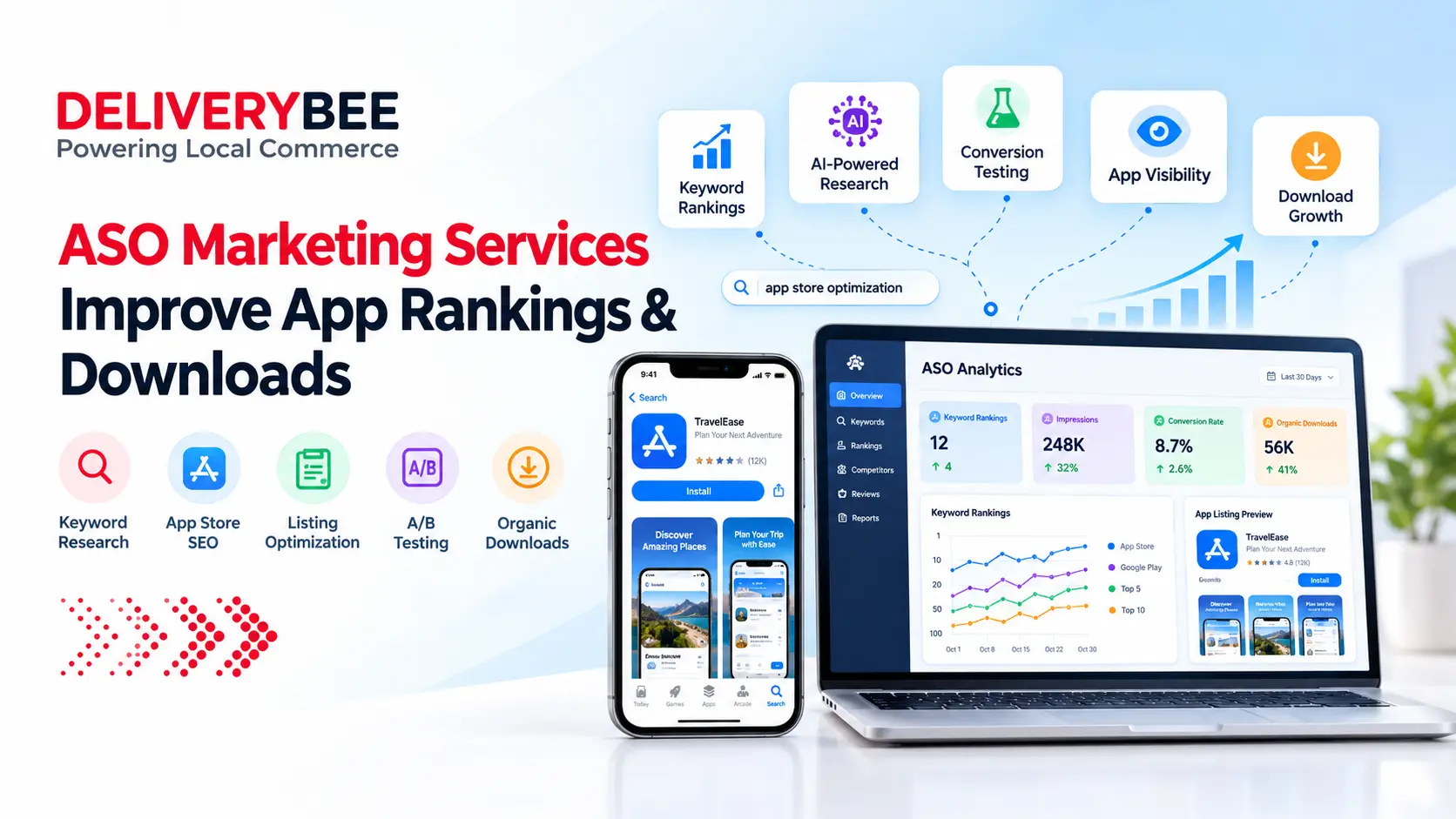
App Store Optimization (ASO) is the process of improving an app’s visibility in app store search and browsing experiences while making its store listing more compelling to potential users. It combines keyword research, competitor analysis, metadata optimization, visual improvements, localization and performance measurement.
A well-planned ASO strategy helps businesses attract relevant users, improve their app listing conversion rate and build a more sustainable organic acquisition channel.
At DeliveryBee, we understand the importance of connecting app development with growth. Our focus on web and mobile application solutions provides a foundation for helping businesses think beyond launching an app and towards building a product that can attract, convert and retain users.
What Are ASO Marketing Services?
ASO marketing services help businesses optimize their mobile applications for discovery and conversion across app marketplaces.
Think of ASO as search engine optimization adapted to app stores. While traditional SEO focuses on improving a website’s visibility in search engines, ASO focuses on making an application easier to discover and more appealing to install through its app store listing.
Professional app store optimization services typically include:
- ASO keyword research and search intent analysis.
- App title, subtitle and description optimization.
- Apple App Store and Google Play Store listing optimization.
- App icon, screenshots and preview video strategy.
- Competitor and category analysis.
- Conversion rate optimization through creative testing.
- App store localization for different countries and languages.
- Ratings and review analysis.
- Organic acquisition and listing performance reporting.
The precise approach depends on the application, its category, target audience, competitors and current performance.
The objective is not simply to rank for more keywords. It is to attract users who are genuinely interested in the product and more likely to install and engage with it.
Why Your Mobile App May Not Be Getting Enough Downloads
A common challenge for app owners is the gap between launching a technically sound application and achieving consistent user acquisition.
Several factors can contribute to this problem.
- Your App Is Targeting the Wrong Keywords
An app may be optimized around broad terms that attract irrelevant traffic or highly competitive keywords that are difficult for a new application to compete for.
For example, a grocery delivery application might target a broad phrase such as “shopping app” instead of researching more relevant terms such as “grocery delivery,” “online supermarket” or location-specific grocery shopping phrases where appropriate.
Effective ASO keyword research considers relevance, competition, search demand where data is available and the intent behind each phrase. - Your App Listing Does Not Communicate Its Value
Users often make quick decisions when browsing app stores. If the app title, description, icon and screenshots fail to communicate the product’s value, potential users may move on to another option.
Your listing should quickly answer three questions:- What does this app do?
- Why should I choose it?
- What benefit will I get after installing it?
Clear messaging can help users understand the product without forcing them to interpret vague marketing claims.
- Your Screenshots Do Not Demonstrate the Experience
App screenshots are not merely decorative images. They can explain the product, demonstrate important features and show potential users what they can accomplish.
For example, a meal subscription app could highlight weekly meal planning, nutritional information, flexible subscriptions and delivery scheduling.
An e-commerce app could focus on product discovery, secure checkout, order tracking and convenient reordering.
The most effective screenshots communicate real benefits and accurately represent the application. - You Are Not Monitoring Performance
Without regular measurement, it is difficult to understand why downloads are increasing or declining.
A listing may receive more impressions but generate few product page visits. Alternatively, users may visit the listing but decide not to install the app.
These scenarios require different solutions.
ASO reporting should distinguish between discoverability, listing engagement, conversion and downstream user quality rather than relying on download totals alone.
How Professional App Store Optimization Services Work
A structured ASO campaign starts with understanding the application and its market before making changes.
- ASO Audit and Baseline Analysis
The first step is to assess the existing app listing and its current performance.
An ASO audit may review:- App title and available metadata.
- Keyword relevance and positioning.
- Category selection.
- App icon and screenshot quality.
- Competitor listings.
- Localization opportunities.
- Store listing conversion performance.
- Ratings, reviews and recurring user concerns.
- Existing acquisition and retention data.
The audit establishes a baseline against which future improvements can be measured.
- ASO Keyword Research
Keyword research identifies the search phrases most relevant to an app’s audience and functionality.
A professional ASO strategy groups keywords into themes based on user intent, product features and business priorities.
For example, a logistics application might investigate phrases related to shipment tracking, courier booking, parcel delivery and delivery management. The final keyword selection should reflect the actual features available in the application.
Keyword research can also identify long-tail opportunities. These are more specific phrases that may be relevant to a narrower audience.
Rather than repeating the same keyword throughout every field, the objective is to use the appropriate metadata fields effectively and maintain clear, natural language.
Keyword opportunities should be validated with available app store data and specialist ASO research tools. Search-volume and difficulty estimates are not guarantees of ranking performance. - Apple App Store Optimization
Apple App Store optimization involves improving the elements that help users understand and discover an iOS application.
Depending on the app and available features, this may include:- App name and subtitle.
- Keyword field strategy.
- Description and promotional messaging.
- Primary category selection.
- App icon and screenshots.
- App previews.
- Supported localizations.
- Custom product pages and product page optimization tests.
Apple provides tools within App Store Connect for testing alternative product page treatments, including app icons, screenshots and app previews. These experiments help developers evaluate which creative options perform better with eligible users. Apple’s product page optimization guide.
The right strategy should follow Apple’s current metadata requirements and review guidelines.
- Google Play Store Optimization
Google Play Store optimization focuses on improving the relevance, clarity and performance of an Android app’s store listing.
Key areas include:- App title and short description.
- Full app description.
- Relevant product and feature terminology.
- App icon and feature graphic.
- Screenshots and promotional assets.
- Custom store listings where appropriate.
- Localized listing content.
- Store listing experiments.
Google Play supports experiments that allow eligible developers to compare alternative graphics and text for their store listings. These tests can help determine which presentation generates better results for the chosen metric. Read Google’s store listing experiment guidance.
Apple App Store and Google Play Store optimization should not be treated as identical processes. Each platform has its own metadata fields, policies and optimization opportunities.
- App Listing Conversion Rate Optimization
Getting a user to view your app listing is only part of the process. The next challenge is convincing that person to install the app.
App listing conversion optimization focuses on the percentage of relevant store visitors who complete the desired action, such as installing or pre-registering for an app.
Improvements may involve:- Testing alternative app icons.
- Improving the order and messaging of screenshots.
- Highlighting the strongest product benefits.
- Making descriptions easier to understand.
- Matching listing messages to user intent.
- Localizing creative assets for specific markets.
- Removing unsupported or confusing claims.
Testing is important because assumptions about what users prefer do not always match actual behavior.
Where traffic is sufficient, structured experiments can help identify which changes produce meaningful improvements. Where traffic is limited, prioritize the most obvious usability and messaging problems before testing multiple alternatives.
How AI Is Changing ASO Marketing Services
Artificial intelligence is making parts of ASO research and analysis faster, particularly when teams need to examine large amounts of keyword, competitor, review and performance data.
However, AI works best as an assistant to an evidence-based optimization process, not as a replacement for human judgment.
AI-Assisted Keyword Clustering
AI tools can group related keywords into themes, identify similar search phrases and help organize terms according to product features and user intent.
For example, an app offering courier services might have separate keyword groups for parcel tracking, courier booking, shipment management and business logistics.
These clusters can help marketers develop more focused metadata and content strategies.
Competitor Listing Analysis
AI-assisted analysis can help compare competitor messaging, feature positioning, screenshot themes and visible listing changes.
This can reveal opportunities to communicate a product’s genuine differentiators more clearly.
The purpose is to understand the market, not copy competitors’ content or make unsupported assumptions about their internal ranking strategies.
App Review Sentiment Analysis
User reviews contain useful information about customer expectations, frustrations and frequently requested features.
AI can help categorize reviews into themes such as payment issues, onboarding difficulties, missing features, delivery delays or performance problems.
Product teams can then use these findings to improve the app experience and identify messages that deserve clarification in the store listing.
Creative Testing Ideas
AI can generate alternative screenshot headlines, value propositions and messaging concepts for testing.
For instance, a delivery management app might test messaging focused on shipment visibility against messaging focused on operational efficiency.
Actual test results—not AI predictions—should determine which approach is retained.
Performance Anomaly Detection
When combined with reliable analytics, automated analysis can help flag changes in impressions, conversion rates, downloads or retention.
Teams can investigate whether these changes correspond to metadata updates, creative experiments, app releases, seasonality or external acquisition campaigns.
AI-generated recommendations should always be checked against the underlying data and the platform’s current rules.
ASO vs SEO: What Is the Difference?
App Store Optimization and Search Engine Optimization share a common principle: helping the right audience discover a product. However, they focus on different discovery environments.
- Area
- Main objective
- Primary platforms
- Optimization areas
- Conversion goal
- Measurement
- ASO
- Improve app discovery and store listing conversion
- Apple App Store and Google Play
- App metadata, keywords, icons, screenshots and store listings
- Installs, pre-registrations or other app store actions
- Store impressions, listing views, downloads and conversion
- SEO
- Improve website visibility in search engines
- Google, Bing and other search engines
- Website content, technical SEO, links and page experience
- Website visits, leads, purchases or other actions
- Search impressions, clicks, rankings and website conversions
For many businesses, ASO and SEO work best together.
A website can attract people searching for a solution, while a well-optimized app listing can help convert relevant app store visitors into users. Website content can also explain app features, answer questions and direct interested visitors to the appropriate app store.
Neither channel guarantees immediate results. Both require ongoing measurement and refinement.
Which Businesses Benefit From ASO Services?
App store optimization can support many different types of applications, provided there is a relevant audience searching for or evaluating the product.
Startups and New App Launches
Startups can use ASO research to understand competitors, identify relevant keyword opportunities and prepare clear app listings before launch.
Early optimization should establish a solid foundation rather than assume that rankings or downloads will arrive automatically.
E-commerce and Retail Applications
Retail apps can emphasize product discovery, personalized shopping, offers, order tracking and convenient purchasing, where these features are available.
Seasonal messaging and localization may also be useful when supported by the business model.
Food Delivery and Meal Subscription Apps
Food delivery and meal subscription applications can highlight ordering convenience, menu selection, delivery coverage, subscription flexibility and other genuine benefits.
Keyword and listing strategies should reflect the actual service area and product capabilities.
SaaS and Business Applications
Business apps can focus on the problems they solve, the workflows they support and the intended users.
Examples include project management, accounting, CRM, logistics and workforce management applications.
Logistics and On-Demand Applications
Courier, shipment tracking, fleet management and delivery management apps can organize their listing around relevant operational tasks and user needs.
For business-focused products, the listing should make the target audience clear—for example, individual consumers, delivery partners or enterprise operators.
Established Applications With Declining Downloads
Existing apps may benefit from an ASO audit if organic acquisition has slowed, competitors have strengthened their listings or the app’s messaging no longer reflects its current features.
The right response depends on the evidence. Sometimes the issue is discoverability; in other cases, the listing converts poorly or the app experience needs attention.
How to Measure ASO Performance
An effective ASO campaign should be evaluated using more than total downloads.
A practical measurement framework includes the following metrics:
Discoverability
- Search impressions and relevant listing visibility, where available.
- Performance for prioritized keywords using suitable ASO tools.
- Discovery trends across relevant countries and categories.
Listing engagement
- Product page views or store listing visitors.
- Traffic sources and localization performance where available.
Conversion
- Download or install conversion rate, using the platform’s defined metric.
- Performance of different listing and creative variants.
User quality
- Activation and onboarding completion.
- Retention and engagement.
- Uninstalls or other relevant product health indicators.
Business outcomes
- Qualified leads, purchases, subscriptions or revenue attributable to app acquisition where measurable.
- Acquisition cost and lifetime value when reliable data is available.
Use Apple App Store Connect and Google Play Console for platform reporting, supported by analytics tools for downstream product and business metrics.
It is also important to distinguish organic downloads from paid acquisition and other traffic sources wherever the reporting tools allow it. This helps avoid attributing every improvement to ASO.
Common ASO Mistakes to Avoid
Even well-intentioned app marketing campaigns can underperform when optimization is approached incorrectly.
- Keyword stuffing: Repeating keywords unnaturally can make listings difficult to read and may violate platform policies. Use relevant metadata naturally.
- Copying competitors: Competitor analysis should reveal market expectations and opportunities, not produce duplicate content.
- Changing everything at once: Making multiple changes simultaneously can make it difficult to determine which change influenced performance.
- Ignoring localization: Direct translation may miss local terminology, cultural expectations and market-specific user needs.
- Using misleading screenshots: Creative assets should accurately represent the app and its real features.
- Buying fake reviews or downloads: Artificial engagement can undermine trust and create policy and account risks. Encourage genuine feedback through appropriate, compliant methods.
- Expecting instant results: Rankings, conversion rates and download trends can change for many reasons. ASO requires realistic expectations and continuous evaluation.
- Measuring downloads alone: More downloads are not necessarily better if users do not activate, return or generate business value.
How DeliveryBee Can Support Your App Growth Strategy
Developing a mobile app and growing its user base are connected but different challenges.
DeliveryBee provides web and mobile application solutions for businesses building digital products. This development perspective can help frame ASO around the product’s actual functionality, intended users and long-term business goals.
An app growth strategy should connect several areas:
- Product positioning: Explain what the application does and why its intended audience should care.
- App store readiness: Ensure that listing content accurately reflects the product.
- Keyword and competitor research: Identify relevant discovery opportunities.
- Creative optimization: Communicate the product’s value through icons, screenshots and other suitable assets.
- Performance measurement: Track meaningful acquisition and conversion metrics.
- Continuous improvement: Use real performance data to prioritize the next changes.
ASO is not a substitute for a good product. The strongest results come from aligning discoverability, clear messaging, a reliable user experience and ongoing measurement.
If you are planning a new application or looking to improve an existing one, start by identifying your current acquisition challenges. That makes it easier to determine whether you need a complete ASO strategy, listing improvements, creative testing or a broader app growth plan.
Frequently Asked Questions About ASO Marketing Services
ASO marketing services help improve an app's discoverability and conversion performance in app marketplaces. They can include keyword research, metadata optimization, competitor analysis, creative improvements, localization and performance reporting.
The timeline varies by app category, competition, existing traffic, listing quality and the changes made. Some listing metrics may respond relatively quickly, while reliable conclusions about keyword performance and sustained organic growth can take longer. Results should be assessed using a baseline and appropriate measurement period.
Yes. ASO can support apps on both the Apple App Store and Google Play Store. However, each platform has different metadata requirements, tools and optimization opportunities, so the strategy should be tailored accordingly.
ASO can improve the likelihood that relevant users discover an app and choose to install it. The impact depends on factors such as search demand, competition, app relevance, listing quality, product experience and market conditions. No provider can responsibly guarantee a particular ranking or number of downloads.
ASO focuses on improving app store discoverability and listing conversion through optimization and testing. Paid app advertising uses advertising budgets to acquire traffic or installs. The approaches can complement each other, but their costs, attribution and performance should be measured separately where possible.
AI can support keyword clustering, competitor research, review analysis, creative ideation and performance anomaly detection. Its output should be validated against reliable data, actual user behavior and app store policies.
Yes, in most competitive categories. User behavior, competitors, app features and market conditions change over time. Regular monitoring and periodic updates help businesses identify new opportunities and respond to declining performance.
Pricing depends on the app's complexity, number of platforms and markets, research requirements, creative production, testing needs and reporting frequency. A practical proposal should follow an initial assessment of the app and its objectives.
Yes. Pre-launch work can include competitor research, keyword planning, category analysis, positioning, listing copy preparation and creative planning. Actual store listing implementation and testing depend on the app's publication status and the tools available on each platform.
Start by reviewing your current app listing, identifying your target users, researching competitors and establishing baseline performance metrics. Then prioritize improvements based on their relevance, feasibility and potential impact.
Conclusion: Build a More Sustainable App Growth Strategy
A successful mobile application needs more than a launch announcement. It needs a clear value proposition, a relevant audience, a compelling app store listing and a process for measuring what works.
ASO marketing services bring these elements together through keyword research, listing optimization, creative testing, localization and ongoing performance analysis.
Whether you are launching a new product or improving an established application, a structured approach can help you make better decisions about app discovery and conversion.
DeliveryBee supports businesses building digital products and planning for growth. If you are looking to improve your app’s store presence or need a broader strategy connecting app development and user acquisition, the first step is to assess your current position and identify the most valuable opportunities.
Ready to plan your app’s next growth stage?
Explore DeliveryBee at https://deliverybee.app/ and get in touch to discuss your application and growth objectives.