Artificial intelligence is changing how businesses plan, manage and monitor transportation.
For logistics and freight forwarding companies, AI can potentially help automate repetitive tasks, identify operational exceptions, optimize transportation decisions and provide predictive insights.
But AI in logistics should not mean adding a chatbot to an existing application and calling it an AI platform.
The real opportunity lies in connecting AI with operational data.
That means combining:
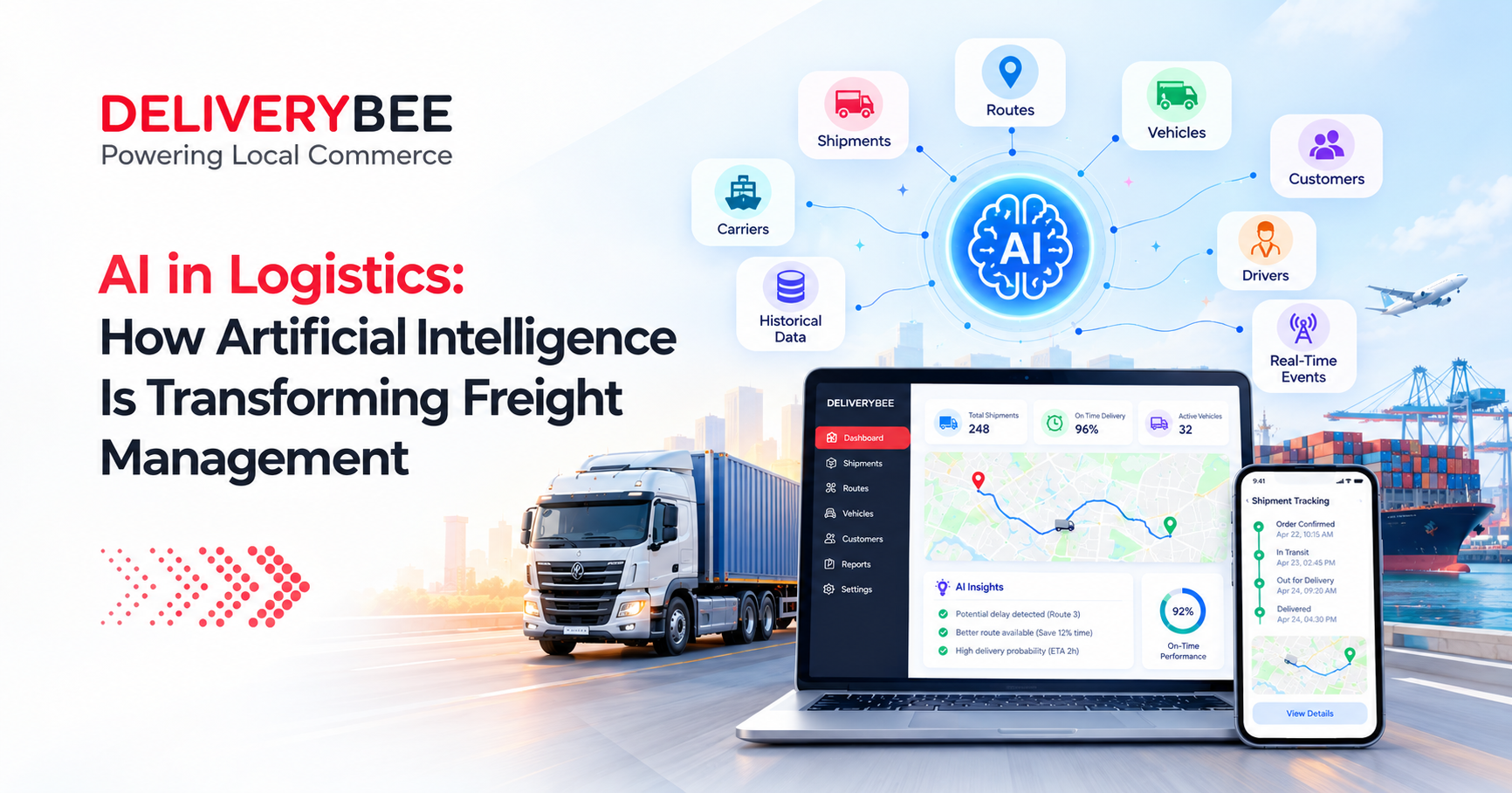
Shipments + Vehicles + Routes + Customers + Drivers + Carriers + Historical Data + Real-Time Events
into an intelligent logistics ecosystem.
Why Logistics Is Suitable for AI
Logistics generates enormous amounts of operational data.
Every shipment creates information.
Every vehicle creates information.
Every delivery creates information.
Every delay creates information.
This data can potentially be analyzed to identify patterns that are difficult to detect manually.
For example:
- Which routes experience repeated delays?
- Which carriers consistently meet delivery windows?
- Which shipments are likely to be delayed?
- Which vehicles are underutilized?
- Which routes create unnecessary mileage?
- Which customers generate frequent delivery exceptions?
AI can help convert operational data into actionable insights.
AI Route Optimization
One of the most practical applications of AI in logistics is route optimization.
A traditional route planner might calculate the shortest route.
An intelligent logistics system can consider multiple constraints.
These may include:
- Vehicle capacity
- Delivery locations
- Traffic
- Delivery windows
- Pickup requirements
- Driver availability
- Shipment priority
- Distance
- Route restrictions
The system can then generate a route designed around the actual business requirements.
Dynamic Route Optimization
The bigger opportunity comes after the vehicle starts moving.
Suppose a driver is assigned ten deliveries.
Halfway through the route:
- Traffic increases
- One customer requests a different delivery time
- Another shipment becomes urgent
- A road becomes unavailable
A dynamic routing engine can recalculate the route.
This creates a more flexible transportation operation.
AI-Powered Shipment Delay Prediction
Another major application is predictive logistics.
Instead of waiting until a shipment becomes late, AI can monitor shipment progress and identify potential problems.
For example:
Historical data may show that a specific route frequently experiences delays during certain periods.
When a new shipment enters that route, the system can flag it as a potential exception.
The operations team can then take action.
This creates a proactive logistics workflow.
AI Freight Rate Intelligence
AI can also assist with freight pricing analysis.
A freight management platform could analyze historical shipment information and help identify patterns in:
- Origin-destination pricing
- Carrier rates
- Seasonal changes
- Transportation modes
- Shipment volumes
- Fuel-related costs
This does not replace human commercial decisions.
Instead, it provides better information for those decisions.
AI Document Processing
Freight forwarding involves documentation.
Documents can contain:
- Shipment information
- Cargo details
- Customer information
- Invoice data
- Container information
- Transportation details
AI-powered document processing can extract structured information from documents and transfer it into the logistics system.
This can reduce repetitive manual data entry.
AI Customer Support for Logistics
A logistics company can also use an AI assistant for customer queries.
Customers could ask:
“Where is shipment ABC123?”
“When is the expected delivery?”
“Show my active shipments.”
“Has customs clearance been completed?”
“What documents are missing?”
The AI assistant can retrieve information from the logistics platform and provide an answer.
AI Logistics Control Tower
A more advanced implementation is an AI-powered logistics control tower.
Instead of showing hundreds of metrics, the system focuses attention on exceptions.
For example:
120 Active Shipments
8 Potential Delays
3 Critical Exceptions
4 Documentation Issues
2 Vehicles Underutilized
The AI layer can prioritize what requires human attention.
This is much more useful than simply producing another dashboard.
DeliveryBee and AI-Powered Logistics Platforms
DeliveryBee develops custom and white-label web and mobile applications using technologies including Python, Laravel, Node.js, Flutter and cloud infrastructure.
Python can be particularly useful when developing AI and data-processing components.
A logistics platform could use a technology architecture containing:
Web Application
↓
Mobile Applications
↓
Logistics Backend
↓
API Integrations
↓
Data Layer
↓
AI/ML Layer
This creates a foundation for intelligent logistics workflows.
SailOn Logistics: A Real-World Logistics Technology Example
DeliveryBee has provided a solution for SailOn Logistics, a company operating in freight forwarding and logistics.
SailOn provides services including ocean freight, land freight, customs clearance, warehousing, project cargo and container logistics.
Its digital platform demonstrates the value of bringing logistics services such as quotation, shipment planning and tracking into an online customer experience.
The next evolution of such platforms can involve increasingly intelligent automation.
AI + Human Operations
AI should not necessarily replace logistics professionals.
In many cases, the better model is:
AI recommends → Human approves → System executes
For example:
AI identifies a potential shipment delay.
The operations manager reviews the recommendation.
The manager selects an alternative carrier or route.
The platform updates the shipment workflow.
This keeps human oversight while reducing repetitive analysis.
Building an AI Logistics Platform
A business planning an AI-powered logistics application should start with operational problems rather than AI features.
Instead of asking:
“What AI feature can we add?”
Ask:
“Where are our employees spending the most time?”
“Which decisions are repetitive?”
“Where are delays occurring?”
“Which operational data are we already collecting?”
“Which processes require manual intervention?”
Those answers can identify the most valuable AI opportunities.
The Future of AI in Logistics
AI is likely to become increasingly integrated into logistics software.
Future logistics platforms will increasingly combine:
- Predictive ETA
- AI route optimization
- Automated dispatch
- Intelligent shipment monitoring
- Document processing
- AI customer service
- Freight analytics
- Exception management
- Demand forecasting
The objective is not simply to make logistics software more complicated.
It is to make logistics operations more intelligent.
For freight forwarders, transportation companies, courier businesses and 3PL providers, an AI-enabled logistics platform can become a central technology layer connecting people, shipments, vehicles and customers.